Driving in Israel

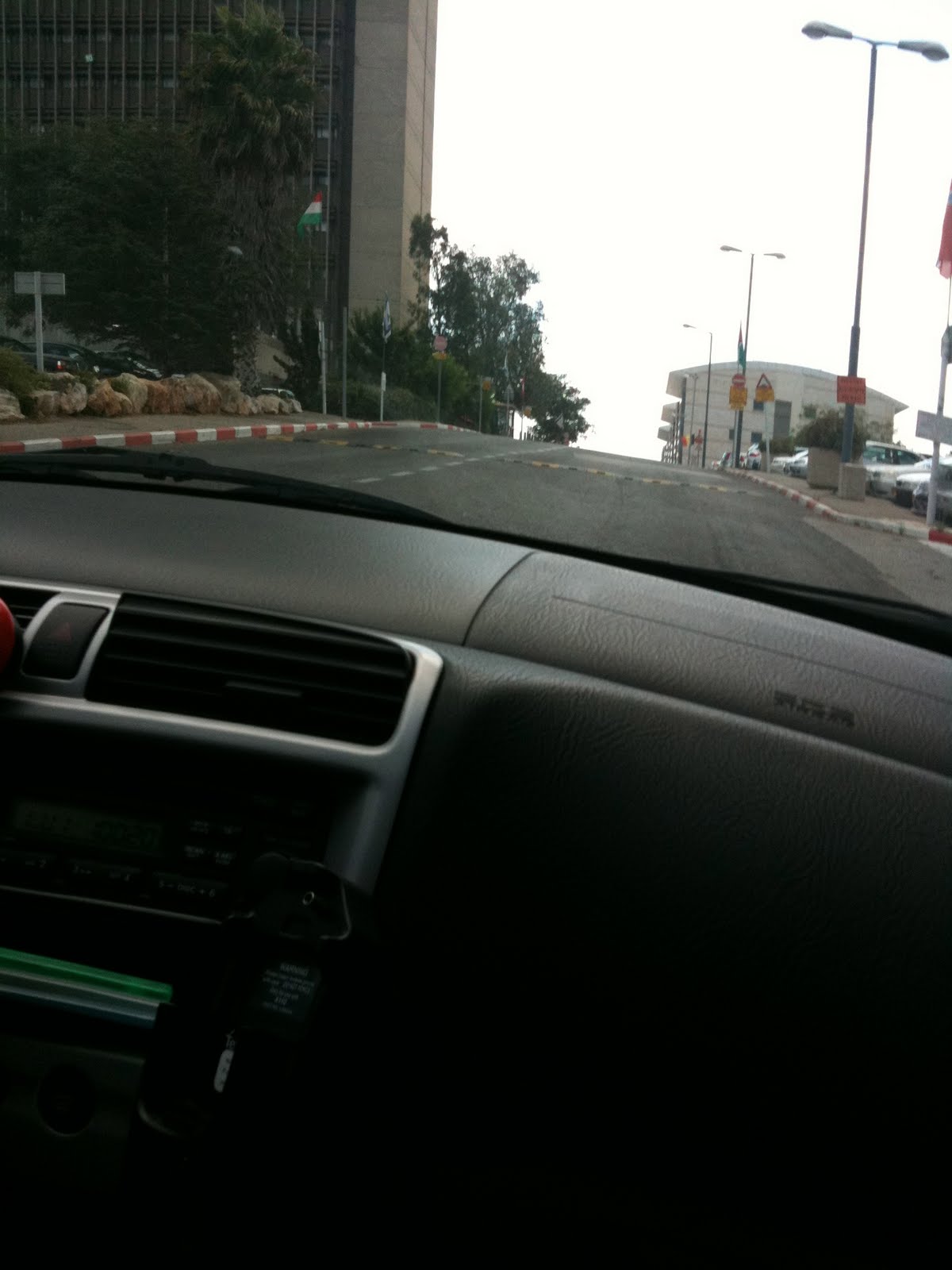
I am not the best driver in the world. 1)I like to go fast when no one is around, 2)roll through stop signs, 3)look at things on either side of the road instead of the traffic in front of me, 4)careen from lane to lane at random and almost always without signaling, and 5) decelerate when I’m thinking so hard about something I forget that I’m driving. (see mistakes 1-5 and repeat). In Israel, I fit right in.

I have no idea why drivers in that country swerve without signaling, or accelerate madly to get to stop lights sometimes and stop without warning at others. Or why they sometimes let you in to traffic circles and sometimes not, or why they park up on the sidewalk, or back up for no reason. I know why I do. I just get preoccupied sometimes.
It’s great. Israeli drivers don’t just honk their car horns, they talk with them. There is a honk for hello, a honk for goodbye, a honk for ‘C’mere, I want a newspaper,’ and a honk for “I’m passing you on a motorcycle, please don’t careen into my lane (see bad action number 4, above).”

Could the immediacy of ancient history be distracting the drivers from the mundane business of looking at today’s road? What importance is the bumper of the guy in front of you when compared with the Roman march of conquest or the brave Judean resistance? How about the pressing existential dilemma of whether the State is the first flowering of our redemption of a people that deserve a homeland or a persistent, insignificant thorn in the claw of the hawk of the Saudi Empire?

I identify with the state of Israel. Hey, Friend! Let a girl merge here! Toot-toot-ooot—BWAAH!

Posted in Driving, Israel | Tagged , , , , , | 1 Comment

At IAJGS is there a woman’s perspective on genealogy?

Since I blog for the Jewish Women’s Archive, I thought that a post about women’s perspectives on genealogy would be a no-brainer.
Then I started looking deeper into the question. I was surprised at what I found.

First, I found a majority of women but not an overwhelming majority. Perfectly consistent with the differences in free time and lifespan between the two sexes.

Second, a lot of couples do genealogy together, husband and wife traveling all over the place to search out the truth of family connections.

Third, there may be no women’s perspective on genealogy, just women’s issues that can be revealed through genealogical techniques.

So in that spirit, I went to a fascinating talk by Raphael Guber on the abuses perpetrated on immigrant women, many of them Jewish, in the late 1800s. And that talk was not recorded because of issues with his agent and publicist–a book is in the works. But it is a a fascinating story, and should be a great book.

Posted in publishing | Tagged , , , | Leave a comment

IAJGS Getting a lot better!

Having a great time with folks who think roots are important!

The International Society of Jewish Genealogists are a worldwide organization that is entirely run by volunteers. This is very different from the Federation, where the machers order the employees around but at least they have standards, or the PTA, where the employees order the machers around,there are no machers and no shleppers in the IAJGS
Just Jews.
Oy. This means that everyone has three opinions, the one they believe, the one they don’t believe, and the one they are not sure of.
But I’ve got to listen to the speaker now.
More later.

Posted in Uncategorized | Tagged | Leave a comment

I missed the food

My Inauspicious Beginnings at the IAJGS Conference

When I heard that Rabbi Shmuley Boteach was going to be a guest lecturer at the 31st Annual IAJGS (International Association of Jewish Geneaological Societies) conference in DC I was very excited.
I do not travel in Orthodox circles but my cousins do, and some of my best friends are rabbis.  To me, Rabbi Shmuley is a big name; a famous man, a hero. He wrote a book called “Kosher Sex,” (which I never read because my husband needs to stay away from salt; you people who know what I’m talking about can talk to me later) and had his own TV show “Shalom in the Home,”  and more importantly, he had the guts to publicly debate Christopher Hitchens.  Of course Hitch made mincemeat out of him, but still, Shmuley had the nerve to publicly debate him, and for that I give him credit.

I live in California, and the IAJGS conference was the penultimate stop in a two week trip I had planned, which began in Jersey City,  included a week at a nice condo near the beach to relax and write in Cape May,  south to the conference in D.C. from Sunday to Thursday and a Friday  visit with one of my dearest friends in Maryland, before going home on Saturday.

The plane tickets were booked and the condo reservations made when Rabbi Shmuley’s appearance at the IAJGS conference was announced. So I did what I do when I get excited these days; I spent money first, thought later. I and bought 4 tickets to hear him speak Friday and Saturday at a dinner in the Grand Hyatt on H Street in DC, despite the fact that the condo in Cape May was reserved until Saturday morning.  I had planned to travel from Cape May to DC on Saturday.

So what time was Rabbi Shmuley speaking on Saturday?

In the original posting on the DC2011 mailing it said dinner. In the later announcements it said  his talk was after havdallah. So, thinking that I could have a precious few more hours watching dolphins frolic, I looked up the time of havdallah, and found that it was 8:00 pm.

So I showed up for a post-havdallah talk. And found, instead of a large banquet hall, set up for dinner and a large crowd to about to enter said hall, a small room with maybe 50 places, and nothing on the tables but empty water glasses challah, and margarine set. It had been self service. The food was gone. The talk was over. And I got furious. If  bought a ticket for dinner, where was the follow-up about the dinner? why did all mention of that dinner disappear from the webpage, to be replaced by havdallah, if there was no havdallah?

One of my friends had suggested that perhaps the dinner and talk was a ‘shaleshudes,’ a Seuda Shlishi, a cold meal served at the end of Shabbat.

“Naww,” I said to her, and thought to myself  ‘Rabbi Shmuley is a big deal. I’m sure they couldn’t organize a whole big dinner appropriate to such a man during Shabbat. So I made plans accordingly, and rolled into my DC hotel around 7. Then I tried unsuccessfully to make my TV display the events planned in the hotel,  something the woman at the registration desk had instructed me to do. So I called, and ran downstairs to a small room in the bowels of the hotel, two levels down.

People were getting ready to sing the Birkat Hamazon, but I was  ready to spit nails. So before they started to sing, I made my one big statement for the night. I banged my hand on the table and said, loudly.
“In what world is Havdallah, dinner and speech the same as what just happened here? I came a long way to hear the Rabbi talk, and it looks like I missed the whole thing. I’m very disappointed”
There was silence.
People said “well, I knew it was dinner”
People said “I’m not responsible for the publicity”
People said “The mashgiach is still in the kitchen, you can get some leftovers if you want.”
People said “talk to the organizers, I’m sure you can get a refund.
What, there were no organizers in the room? No. The organizers were at the table upstairs where I had snatched my badge and practically yelled to the one person who had had any contact with me at all “You should have told me when dinner was.”

This brings up all sorts of issues for me.  Issues of being an outsider not included. Issues of reconciliation between Jews who ride on Shabbat and those who don’t. Issues of Orthodoxy vs. Liberalism. Issues of being and only child in a world of siblings. Issues of being the only Preeva.

During the benching, I went over to Shmuley’s table, where I planned to sit respectfully until the singing was over.
Much to my surprise, he spoke to me.
“Where did you come from?” he asked. I told him, California.
“You ride on Shabbat?”
I told him yes.
“I’m very sorry for the misunderstanding,” he said.
I asked him, if he could, to please summarize the talk he had given, if he could.
The rabbi graciously agreed.
“I spoke about internal identity vs external identity,” Rabbi Shmuley said.
“External identity is what we do, our titles, what we have. Internal identity is who we are. Geneaology is important because it is taking your ancestors, who are anonymous, and honoring them because they are important to who you are. Celebrity worship is very common in this country, and that is idolizing people who are famous.  But when take anonymous people who are important to you, and recognize them, that’s discovering who you are.”
Or something like that. My memory is not that great.
But then the benching ended, and the Rabbi had to go somewhere else, and I went out out into the hall to stand in line for registration at the larger conference, and the one person whom I had spoken to, it turns out I had hurt her feelings.

“I’m sorry you missed the Rabbi, but I did not deserve you yelling at me,” she said.
And she is absolutely right. Now I have to apologize.

I hope the rest of the conference goes better than this.

Tagged , , , , , , | Leave a comment

June 17, School Matters

Here, I wondered about  the schools and their Green Teams.  Green  Waste, Palo Alto, has been working with the schools to sort their trash into recycling and compostables and trash. The idea behind the program is simple–we throw out a lot of good stuff that can be re-used.  A recycling coordinator from Sacramento got excited about spreading the recycling efforts to Sacramento schools!

June 17, 2011

Posted in Uncategorized | Tagged | Leave a comment

June 10, 2011 School Matters

This column was about the achievement gap.  There is a substantial difference in test scores and college attendance between ‘students of color’ or ‘Tinsley Kids’ in Palo Alto and everyone else.  The ‘Tinsley Kids’ are students from East Palo Alto who choose to go to school in Palo Alto.  A lot of them don’t end up going to 4 year colleges. They graduate from high school, but they don’t have the courses needed to go to the University of California system.  This is possible because you can graduate from high school in Palo Alto without learning advanced algebra.  The head of the school district wants to make the standards to get into UC the standard for graduation, and oh, boy, the board meeting lasted until after 1 am.- I asked Anna Waring, the head of an organization that helps East Palo Alto kids get into and graduate from college, what she thought. She told me she thought that students of color were not held to a UC standard curriculum BY THE STAFF OF THE HIGH SCHOOLS, that she had to help parents advocate to keep their students of color in the right classes. I wrote a column about it. Nobody commented.

June 10th column


Posted in Uncategorized | Tagged | Leave a comment

“These are excellent Blintzes”

Said my Yiddish teacher, Sascha, yesterday as he finally gave in and ate the blintzes, crepe-like pancakes filled with a slightly sweet cheese mixture, folded, and fried in butter.

And was he ever right. These were fresh as they get.  An hour before Sascha made his comment, these blintzes were individual ingredients in the fridge.

I made the blintzes (singular: blintz) for my Yiddish class in honor of Shavuot, the holiday that comes 49 days after Passover.  Shavuout is a huge deal in the Bible. It  commemorates the giving of the Law at Mt. Sinai, and often there are all-night study sessions.  In the Bible, Shavuot is a pilgrimage festival where the first fruits of the year are delivered to the priests.  In Israel, on farms and in the country, and also in Palo Alto when Jewish preschool teachers feel like it, little children are dressed in white, wear garlands on their heads (CUTE!)  and present baskets of flowers and produce to the poor.  Shavuot  has sort of degenerated into an excuse to eat dairy products.

Thus the blintz. Because  Hubby was not in the house, I used the richest recipe I knew. Which was also the easiest recipe. And the most delicious.

The Blintz consists of two parts: the skin, or “bletel,” (Yiddish for leaflet)
I used Joan Nathan’s recipe: 1 cup flour, one cup milk, one tablespoon soft butter, 3 eggs, processed in blender for 15-20 seconds, then let rest for 15 minutes, then coated the bottom of a heated and greased omelette pan (small, maybe 8 inches across) and cooked the bletlech until they released from the pan.

 and the stuffing, which undoubtedly has a Yiddish word, but I don’t know it.
Because two of the people in my Yiddish class are Russian, and I was near a store that carried it, I bought a dairy product called “Sweet Kiss,” which was a smooth, not-quite-yogurt cream that had raisins and sugar in it.  Well, actually it was corn syrup, but I didn’t know that until I was cleaning up. The Russians call the stuff “Trowrog,” or something like that.
I mixed the “Sweet Kiss” with Friendship Farmer’s Cheese, which is what my mom used for blintzes, along with an egg.

This is not a low fat dish.

Anyway, blintzes are assembled by taking a bletel,  laying it cooked side up, and putting a spoonful of filling near the lower edge of the circular pancake, folding up the bottom, folding the edges in, and rolling the blintz up.  Now it is a blintz.  It needs to be fried in butter to be complete.

I served mine with Apricot jam.

After Sascha ate one plate of blintzes, he ate another plate full.

We all enjoyed it.

Tagged , , , , , , , | 1 Comment

Can’t Eat Beef? Try this!

Great New Dish I concocted for my  Seder

I love my brother in law, G.  He knows what he likes, and what he likes is beef. And so do I. So every Passover since 1990, ‘to make G happy,’  I roasted a whole prime rib of beef.
I bought a whole prime rib the first time because the kosher butcher in San Jose I ordered it promised me a would be cheaper price per pound  for me if he did not have to cut it up.  So I told him OK, not knowing what a whole prime rib looked like, weighed, how much it would cost, or ever having cooked one before.  I had eaten prime rib in restaurants, though, and  liked it. The butcher referred me to had several excellent cookbooks which I had at home, and promised I could call him up if I got into trouble. And my mother was with me at the time, and liked the butcher, and wanted to support his business.  So fine, I said to the butcher, order me a whole prime rib, whatever.

When I got the call that my order was ready and I  came to pick it up, and I saw that a whole  prime rib was a hunk of meat trussed up in string netting, that was almost a foot wide, and almost a yard  long, cost $18 a pound AFTER the discount, and weighing in at 18 pounds, cost over 300 bucks.  

This afterthought to my Seder, which I  had only gotten to make G happy and give him an alternative to turkey (and to be fair, because I hate brisket), spoke up for itself and said “I am not a piece of fruit! ATTENTION MUST BE PAID!” So I NAMED the thing, called it The Beast, and duly added it to my Passover shopping list along with wine, matzas, potatoes, and dozens of eggs.

Traditional Passover is not a holiday for the heart healthy.  If our forefathers in Europe had been able to afford adequate quantities of the traditional foods like brisket and potato kugel for dinner and matza brei and sour cream for lunch, they would have dropped dead in the Old Country of heart disease long before they emigrated to America. But that is another story.

We all loved The Beast, our own Passover sacrifice. I laced it with garlic just like Julia Child showed me on TV. I rubbed it with salt and spices. I lay it on a bed of peeled and quartered potatoes, which absorbed the garlicky and spicy drippings form the meat and became delicacies in their own right,  The Beast was fragrant and fatty and beefy and crisp,  just what our ancient hunter-gatherer metabolisms crave.  

But the ancient hunter-gatherers died young. And G. almost died young,  after he had two angioplasties  6 months apart in 2010.  The Beast got kicked off the Passover shopping list in 2011.  The fish and white meat turkey meatballs and lowfat kugel made with egg substitute, and lowfat vegetable kugel made with spinach, fennel, peppers and carrots remained in the menu. I knew this menu would not please G, so I started looking for an alternative to the Beast.
 I needed to serve something that was rich and good to chew, and a deep brown, to contrast with the light brown turkey meatballs and pinkish planked salmon, and green vegetables I serve.   I found a recipe for Passover brisket in the New York Times from a New Orleans chef, and, since G loves mushrooms and wine, decided that these fusion of Cajun and Asian flavors would work just as well for Portobello mushrooms as point cut brisket. And they do.

  The mushrooms  are a very different type of  trouble to make than The Beast, which drove my entire Passover preparations (step 1 to making Pesach was: Empty freezer completely to make room for Beast)  and lasted right through the 8 days, but they were a big hit.


 Mushroom Ragout with wine, almonds and dried plums


  • 10 extra large Portobello mushrooms, sliced diagonally into slices 1/2 inch thick
  • Salt and black pepper
  • Safflower oil and PAM, for frying.
  • 1 large yellow onion, diced
  • 2 large carrots, peeled and diced
  • 2 stalks celery, diced
  • 3 cloves garlic, peeled and smashed
  • 1 1-inch piece ginger, peeled and smashed
  • 1 cups Concord grape wine (like Manishewitz)
  • 1 cup dry red wine
  • 1 cups pitted prunes
  • 1 cup slivered almonds, lightly toasted
  • 4 ounces shiitake, crimini or other mushrooms, diced
  • 1/2 cup (loosely packed) chopped parsley
  • 4 sprigs fresh thyme
  • 1 bay leaf
  • 1 stick cinnamon
  • 1 clove
  • 1 star anise
  • Zest of 1 orange, in strips
  • 1 can condensed chicken stock, and water to cover.
1. Heat oven to 325 degrees. Season portobello mushrooms with salt and pepper. Place a heavy wide pan over medium-high heat. Add oil and heat until shimmering. Add mushroom slices and brown well on both sides. Transfer to a plate.
2. Add onion, carrots, celery, garlic and ginger to the pan, and stir until the onions begin to brown, about 3 minutes. Add both wines, scraping the bottom of the pan with a wooden spoon. Simmer until reduced by half, about 10 minutes.
3. In a large Dutch oven or heavy braising pan, combine 1 cup of the prunes, 1/4 cup almonds, and the chopped mushrooms. In a piece of cheesecloth, tie up 1/4 cup of the parsley with the thyme, bay leaf, cinnamon, clove, star anise and orange zest, and add to the pot. Add the mushroom slices, the vegetable mixture in its reduces wine sauce, and the chicken soup. Add water to cover. Place over high heat to bring to a boil, then transfer to the oven.Cook, covered for another hour.
Garnish with remaining 1/4 cup parsley and 1/4 cup almonds.
Yield:10 to 14 servings.

Posted in Uncategorized | Tagged | 1 Comment

Great Beef Alternative Entree for Seder

I love my brother in law, G.  He knows what he likes, and what he likes is beef. And so do I. So I served it to him every Passover, a big, honkin’ prime rib of it.  A whole Kosher prime rib of beef.  I called it The Beast, and it was on my yearly list along with wine, matzas, potatoes, and egg substitute that I used to cook stuff for my other brother in law, S, who swore off cholesterol in the 1990s.

We all loved The Beast, our own Passover sacrifice (Kosher prime rib is about $18/pound). I laced it with garlic just like Julia Child showed us to. I rubbed it with salt and spices. It was fragrant and fatty and beefy and crisp,  just what our ancient hunter-gatherer metabolisms crave.

But ancient hunter-gatherers died young. And G. almost died young, except for the two angioplasties he had 6 months apart last year.

So The Beast got kicked off the Passover list, and I searched and searched for a good replacement.  And I found a recipe in the New York Times from a New Orleans chef, and, since G loves mushrooms and wine, decided that those flavors would work just as well for Portobello mushrooms. And they did.  The mushrooms go well with the potato kugel I make with the egg substitute.

 Mushroom Ragout with wine, almonds and dried plums


  • 10 extra large Portobello mushrooms, sliced diagonally into slices 1/2 inch thick
  • Salt and black pepper
  • Safflower oil and PAM, for frying.
  • 1 large yellow onion, diced
  • 2 large carrots, peeled and diced
  • 2 stalks celery, diced
  • 3 cloves garlic, peeled and smashed
  • 1 1-inch piece ginger, peeled and smashed
  • 1 cups Concord grape wine (like Manishewitz)
  • 1 cup dry red wine
  • 1 cups pitted prunes
  • 1 cup slivered almonds, lightly toasted
  • 4 ounces shiitake, crimini or other mushrooms, diced
  • 1/2 cup (loosely packed) chopped parsley
  • 4 sprigs fresh thyme
  • 1 bay leaf
  • 1 stick cinnamon
  • 1 clove
  • 1 star anise
  • Zest of 1 orange, in strips
  • 1 can condensed chicken stock, and water to cover.

1. Heat oven to 325 degrees. Season portobello mushrooms with salt and pepper. Place a heavy wide pan over medium-high heat. Add oil and heat until shimmering. Add mushroom slices and brown well on both sides. Transfer to a plate.

2. Add onion, carrots, celery, garlic and ginger to the pan, and stir until the onions begin to brown, about 3 minutes. Add both wines, scraping the bottom of the pan with a wooden spoon. Simmer until reduced by half, about 10 minutes.

3. In a large Dutch oven or heavy braising pan, combine 1 cup of the prunes, 1/4 cup almonds, and the chopped mushrooms. In a piece of cheesecloth, tie up 1/4 cup of the parsley with the thyme, bay leaf, cinnamon, clove, star anise and orange zest, and add to the pot. Add the mushroom slices, the vegetable mixture in its reduces wine sauce, and the chicken soup. Add water to cover. Place over high heat to bring to a boil, then transfer to the oven.Cook, covered for another hour.

Garnish with remaining 1/4 cup parsley and 1/4 cup almonds.

Yield:10 to 14 servings.

Posted in Uncategorized | Tagged | Leave a comment

Pesach on South Beach

MONDAY, APRIL 11, 2011

Passover on South Beach
Pesach in South Beach

When we conduct the Seder, matza is called ‘the bread of affliction.’

Because strictly observing the commandment in Deuteronomy  does not just mean eating  matza instead of bread–if you take it seriously, Passover means no products made from any dough, or anything that is cooked with water and swells. That means no pasta, no noodles, no rice, no barley, no cookies, no corn,no soybeans or soy products, nothing made with corn syrup, only specially prepared extracts because regular extracts are made with grain alchohol. Oh, yes, and the swelling in water thing means no beans, no peas, no legumes of any sort.*

Matza is dense, and dry,and leaves an unbelievable amount of crumbs around the house. It can’t be toasted, and it does not satisfy the appetite. It breaks erratically, and scratches the roof of your mouth if you are not careful. Because it does not absorb water very well, it does not flow smoothly through the digestive tract.

This is why we call it the ‘bread of affliction’ a couple of days AFTER the Seder.


One thing about matza, though; it is an exquisite platform for good butter, or cream cheese with a good jam on top. This may be why two common problems Jews have with Passover are constipation and weight gain.


But you know what? Going through my old computer files, I found this, which I wrote in 2006.

I usually lose weight on Pesach. Last Pesach, I lost 5 pounds. The Pesach before that, I lost 3.
How do I do that, you ask? Between the matzo and the macaroons, the Jell-rings and the fruit slices and the blandishments of Barton’s Candy?
Simple. Give up carbs during the holiday.

I started this practice about 15 years ago, when I was working at Common Ground with a macrobiotic cook. When we were talking about Passover, she made a very interesting remark: “So you give up yeast for a week? How healthy!” Then she spoke about all the things people eat when they can’t eat yeast because of something called Candida, or when they can’t eat wheat, and that got me to thinking about why I ate as much Matza on Passover as I did, and the only answer was: “because I always have.”
Well, feh on that! Here I was in California, mistress of my own household! I was tired of the weight gain on Passover, tired of the cycle of running to the chocolate because I felt sorry for myself eating matza, Also tired of the natural consequence of all that matza.
So I gave up the perforated bread of affliction, and brought nuts and dried fruit and cottage cheese for lunch at the store instead of matza pizza, had scrambled eggs with veggies for breakfast instead of matza brie, and instead of serving matza kugel with our dinners of Seder leftovers, I steamed a bunch of broccoli and green beans (or carrots), instead.

Giving up matza and substituting fruits and vegetables involves a lot of trimming of produce, but I had 3 compost devices going at the time, so that was no problem.
When the low-carbohydrate craze of South Beach hit in 2000-something, I wasn’t surprised at all, I just nodded my head and said “Aha, I’ve been spending Pesach on South Beach all these years.”

How to have a Low-Carb Passover

Make sure you have containers on hand for your leftovers and pre-cut produce before the holiday starts.

Serve a roast turkey, a roast beef, and baked instead of gefilte fish at your seder, for lots of convenient leftovers. You may not have to turn your oven on for the rest of week.

Only make enough Matza balls for the seder. Floaters or sinkers, they are too good to resist, so restrict yourself.
Have a couple of cans of stewed tomatoes around for making a good soup from the turkey carcass.

Have lots of eggs and/or egg substitute in the house.

Keep containers of peeled and cut carrots, cucumbers, celery, jicama, snow peas, and other family favorites in the fridge, like melon (I have a lot of melon memories). Put the vegetables out after school on plates with some dip available, and the kids will eat them.

Remember California is the land of fruits and nuts. Eat those.

Do not check your cholesterol.

What to do with leftover Matza:

Put it in the compost pile
Use it as mulch
Leave on the ground in front of the windows to act as an inexpensive audible burglar alarm and thief tracking system.

*because, frankly, the rabbis who wrote these rules in Europe in the 1400s were ascetic sadists who lived on an entirely different plane of existence than the poor women who actually had to live with these rules, bearing endless children and maintaining businesses to feed everyone. I’m amazed that this lifestyle persists among the Orthodox Jewish community to this day.

Posted in Uncategorized | Tagged , , , , , , , , | 1 Comment