What to serve with latkes?

Two crockpots full of Kosher Meatballs and a Pot of Leafy Vegetable Stew

Beef Meatballs

4 lbs ground beef (15 percent fat)
2 small onions, chopped
4 eggs
1 cup breadcrumbs
1/2 tsp pepper

In two batches, because this is too much stuff for even a large household bowl, combine the ingredients and mix well. On a large cutting board, pat meat mixture into a slab one inch thick, and cut slab into one inch squares. Cutting the ground meat slab into squares helps you make evenly sized meatballs. Roll meat cubes into balls, and brown the meatballs on at least two sides. Put meatballs into an aluminum pan in fridge to cool quickly, then you put cooled meatballs into a Ziploc bag to reheat on party day.

Sauce for Beef Meatballs (haul out the food processor for this)

1/4 large red onion, sliced thinly
1/3 cup water
1/2 lb white and/or brown mushrooms, sliced thinly
Two pinches pepper
Safflower oil for saute

2 cups water
2 TB worchestershire sauce

In a large dutch oven, lightly brown onion, then add water and cover, and cook the onions for 20 minutes more over medium low heat.
Turn up heat, add mushrooms, cover and let them cook for another 20 minutes or more, until the moisture in the mushrooms comes out. Add pepper.
Add 2 cups water, deglaze pan, (don’t take mushrooms out) and add meatballs and worchestershire sauce. Reheat gently, and when meatballs are warmed through, put into crockpot set on high.

Turkey Meatballs
Get your crockpot plugged in and positioned close to the stove. Turn to
high setting.
Add 3 cups water 4 large bay leaves,and 2 TB vegetable boullion mix to crock pot. Cover and let water heat.

3 lbs ground white meat turkey
2 large white onion, grated or chopped fine, depending on the state of your shredder blade.
1 cup corn flake crumbs, divided 80/20
Splash of water
6 egg whites
1-2 TB Herbes de Provence

Put turkey meat and grated onion in bowl. Make a well in the meat and add the first part of the cornflake crumbs to the meat, and add a splash of water to the cornflake crumbs. Let the crumbs absorb the water for a few seconds, and then add egg whites and herbes de Provence and mix thoroughly. You should use your hands for this. Add reserved corn flake crumbs if meatball mixture is too loose to form meatballs

Fill a cup or bowl with cold water. Wet your hands, and make meatballs about 1 inch across. Fill up a plate with those.

Then, heat safflower oil in a very large nonstick skillet, and brown the turkey meatballs on at least 3 sides. Do not crowd meatballs. Use a spatula to turn the turkey meatballs over, or start them rolling as soon as they hit the pan by shaking the pan. This might cause the oil to slop out and flame up. which we see on the food channel a lot. When meatballs are browned, add the meatballs to liquid in crock pot to poach. After all the meatballs are formed, browned, and added to crock pot, deglaze pan with:

1/2 cup Pumpkin Ale, and water if needed.
Add that to crock pot. Turn down heat to low and let cook for 1-4 hours.

Leafy veggie stew

4 large leeks
Safflower oil
2 cans Trader Joe’s artichoke hearts, packed in water
2 packages frozen spinach
1 package frozen peas
1 TB Manishewitz Brisket seasoning (onion powder, salt, sugar, caramel color, garlic powder chili flakes)
Salt
Pepper
3 TB cornstarch in one cup of water.

Clean and cut white and light green part of leeks into 3 inch sections. Slice thinly with slicing disk in food processor. Add leeks to large pot and Saute in oil 3 minutes, then cover and sweat the leeks for 5 minutes. Slice artichokes thinly and add to leeks. Add seasoning. Put in 2 packages frozen spinach and cover and cook until spinach is thawed and cooked through. Add peas and heat. Salt and pepper to taste. Thicken with 3 TB cornstarch mixed with one cup water. Heat and stir until thickened.
Posted in latkes | Tagged , , , , , , , , , , , , | Leave a comment

Macaroni and Cheese


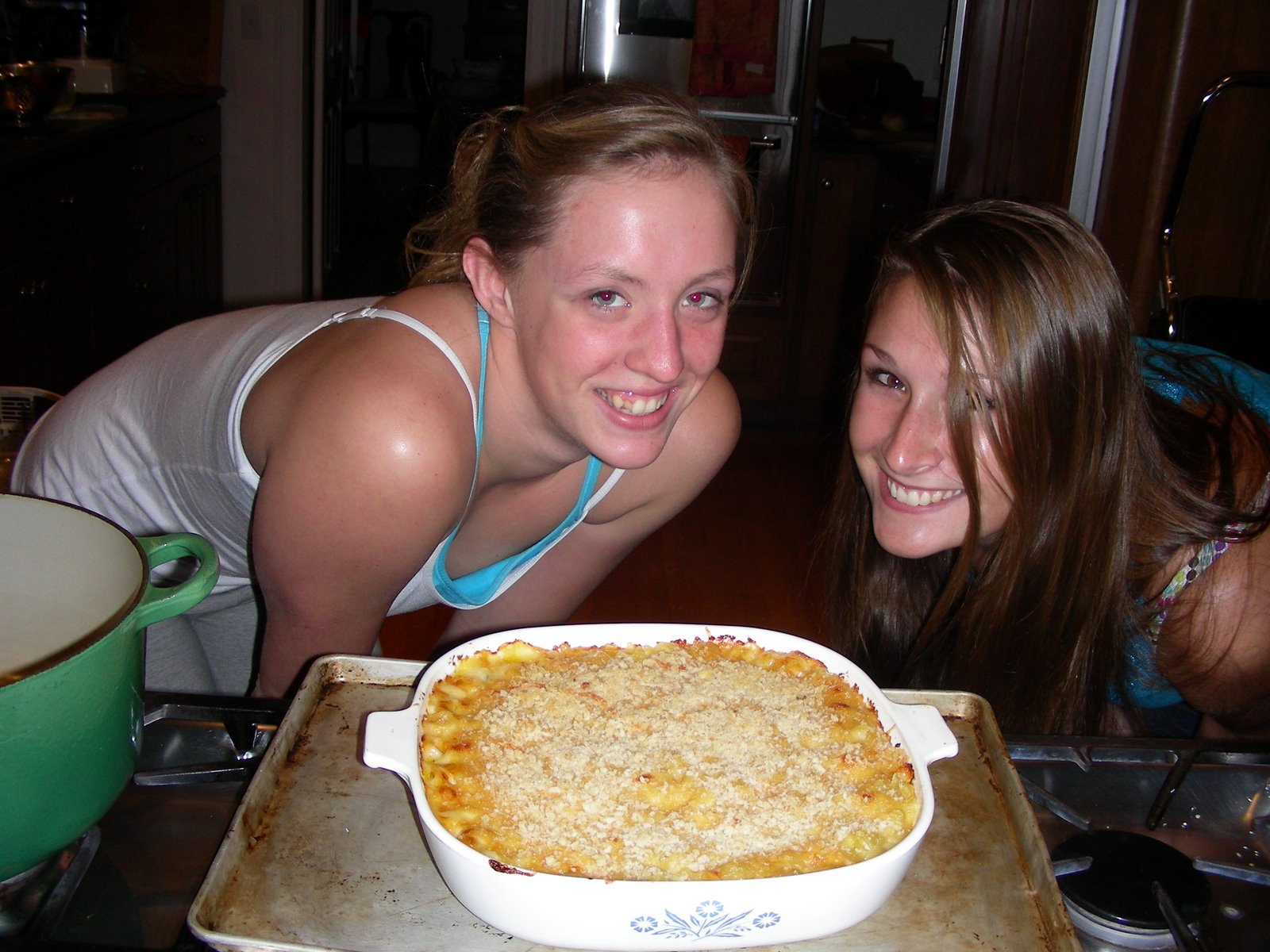
On the day after Thanksgiving, I showed two of my son’s friends how to make Macaroni and Cheese. Real Mac and Cheese–white sauce, breadcrumbs, baking, the whole deal. It took an hour, as real Mac and Cheese tends to do, but it was good.

Posted in Uncategorized | Tagged | Leave a comment

Frittatas


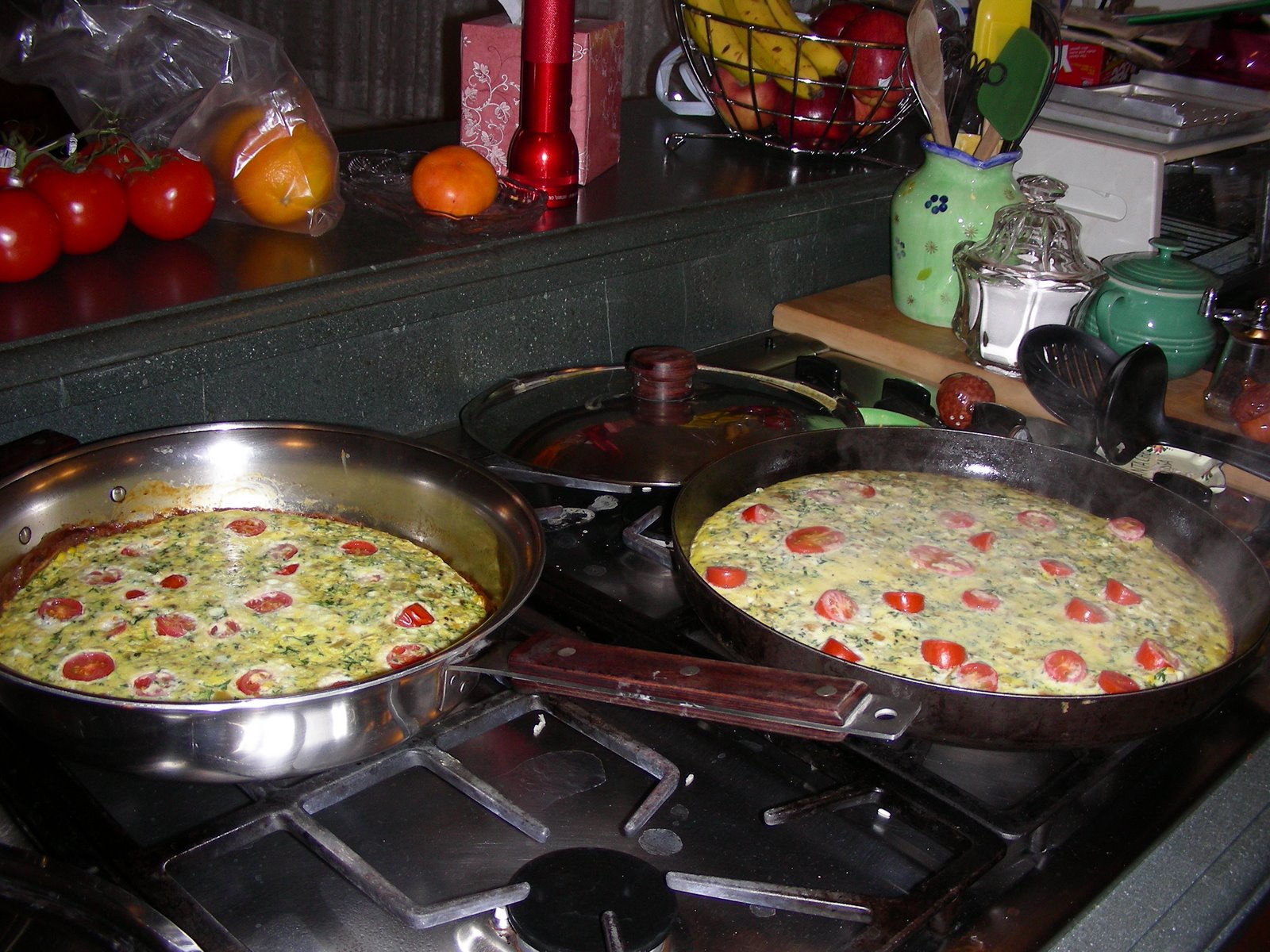
Made 3 frittatas, with 8 eggs each, for the Staff appreciation brunch Nov. 12. Very healthy. Very low-fat. Very pretty.

Posted in Uncategorized | Tagged | Leave a comment

Whoa, it has been awhile!

I’m still on Weight Watchers. I’ve lost 21 pounds, and I’m sort of stuck on that plateau. But life goes on. I’m VP Hospitality for the Palo Alto PTA Council, and cooked a lot of food for the Staff Appreciation Brunch Nov. 12, including a great frittata that I will post the recipe for.

Posted in Uncategorized | Tagged | Leave a comment

Weight Watchers and the Food Blogger

I’ve been on Weight Watchers for the past month. I have lost 10 pounds, but lost my will to cook. So, except for meditations on flaxseed meal as a substitute for eggs, and the merits of hummus made with minimal olive oil, there’s not much to say.

Weight Watchers has several good cookbooks,and I have cooked several good recipes from them. But I miss fat. And refined carbs. And ice cream. And I am sick of salade nicoise. Sigh. I’m so spoiled. Sue me.

Posted in Uncategorized | Tagged | Leave a comment

Robot Mom

Guest Opinion: Working together is not just a robotic thing
appeared in the Palo Alto Weekly, April 9, 2008
by Preeva Tramiel

I am a robot mom.

My sons have been building robots for so long it looks like Fry’s, Halted and OSH have partied in my basement and thrown up. On many mornings, I wake to the sound of metal, plastic or carbon fiber being drilled or cut.

My ongoing questions to my sons are things like, “Why can’t these robots clean up after you?” and “What is a band saw doing under the wet bar?”

So when they joined the robotics team at Paly, I was relieved. They worked on robots at school. The house became much quieter.

I started sponsoring the Paly robotics team in 2005, in a year when finances were especially tight for the team and I had two sons participating in robotics, on at Paly and one on his own. Once I made an investment in Paly Robotics, I looked harder at it. Adviser Doug Bertain really lets the kids figure things out for themselves.

Frankly, this initially annoyed me. I had made an investment, and I wanted the kids to WIN. I have friends with children at Gunn High School, and I always sort of looked at their program with envy. They always seemed to do more, and get more, and have more success. I heard rumors that the Gunn parents spent hours and hours helping their children.

I heard that Gunn parents persuaded their companies to contribute to the team, raising a ton of money. I know the Gunn parents brought their kids dinner after school and let their children dye their hair red, because it was “a team thing.”

Gunn won a President’s award and went to Atlanta one year, and always ended up near the top of the list of teams at the seeding matches at the tournament in San Jose, and went to the quarterfinals and semifinals.

Paly never did anywhere near as well when I was watching. Last year, when the Paly team finished near the bottom at the Silicon Valley Regional, I’d have conversations like this about three times a week with acquaintances from the Gunn community:

“Oh, your kid is on the Paly Robotics team? My kid is on the Gunn team,” they would say.

“Oh, your kid does robotics? Good for them,” I would reply, as I cringed inside, anticipating the next question: “How did Paly do this year?”

“Well, last year they won a first place medal in Vegas,” I would say, knowing that at the Silicon Valley Regional, Gunn was in the top half every year, and Paly was not.

The Gunn parents were very gracious, and said, “Good for them. Better luck in San Jose next time.” Sometimes they added, “Our kids worked really hard on their robot.”

And then, to add insult to injury, the Gunn team had the Capitol Steps perform for a fundraiser last year. I love the Capitol Steps, but because I’d have to face that conversation again and again if I went, I didn’t go.

So I drove down to San Jose State to watch the Silicon Valley Regionals of FIRST (a national program, “For Inspiration and Recognition of Science and Technology”) Saturday, March 16 2008, not quite knowing what I’d see.

I got a chance to see something new and inspiring: The Gunn and Paly robotics teams had joined forces and formed an alliance with a team from Hilo, Hawaii. Together they almost won the tournament.

FIRST tournament seeding is based on points earned in 10 seeding rounds, with six robots in the arena, jostling for points. Each year there is a different task the robots need to do besides just whizz around the track. The task this year was to pick up 40-inch-diameter balls and push or throw them over a six-foot trestle.

Whizzing around the track gets points. Throwing the ball over the rack gets points. Bonus points are awarded if your ball is on the rack at the end of the round, so there is incentive to knock other teams’ balls off the rack.

After the seeding rounds, the top eight teams get to pick two partners, and these teams of three, called “alliances,” face each other in the quarter, semifinal and final rounds.

The alliance that wins the final round gets to go to the championship in Atlanta, Georgia. The team that wins the President’s Award also gets to go to Atlanta.

There were favorites. Team 100, from Woodside High, always does well, and so does the team from Bellarmine, which brings a machine shop to the competition and works with NASA engineers every year. Those two teams formed an alliance with Monte Vista High of Cupertino.

Paly had done a lot of scouting, strategizing and shmoozing, and somehow figured out who was going to ally with whom. Team members talked themselves into an alliance with seeds number 2 (the Warrior Pride from a high school in Hilo, Hawaii) and 3 (Gunn).

From what I saw, Paly team Captain Daniel Shaffer was the one who conducted the negotiations after the seeding rounds.

I saw a whispered conversation, a handshake and a smile. I saw the picking of the alliances, and saw Paly get picked to join the Gunn-Hilo alliance.

And that was enough for me. This had nothing to do with politics, and everything to do with mutual interest fostered by competition. Gunn and Paly allied because they wanted to win, and they almost did.

I think this is the only time Gunn has been in the finals, and the contest was so close it is being re-examined. Gunn and Paly may go to the nationals in Atlanta after all.

There’s a broader context to this story.

I’ve been in Palo Alto a long time. I’ve been at Paly for five years and currently serve as president of Paly’s Parent-Teacher-Student Association.

And I am tired of the inter-school rivalry. The parent communities of the two schools, especially Gunn, are always evaluating the other’s school’s money and position with the district and pointing at imagined inequities.

“Paly got a new pool,” Gunn parents say, ignoring their beautiful new library.

“Paly has a much older donor base, so you can raise more money,” Gunn says, ignoring the fact that after a while, the donor base dies.

“Paly recruits for its sports teams,” Gunn says, ignoring the fact that what Paly does is expect excellence from its coaches, and good athletes flock to good coaches.

At the same time, Gunn comes out on top of Paly in the national and statewide academic rankings, year after year. What is Paly supposed to do, set traps outside the calculus classes and drag the good students downtown?

Any realtor will tell you that Gunn is more in demand as a location to buy or rent.

Yada, yada, the heat goes on.

That is why I was so pleased to see robotics teams cooperate during the Silcon Valley Regionals.

And it hasn’t stopped there. The two PTAs coordinate parent education programs, and the student bodies have held a dance together.

Seeing the robotics teams work together and almost topple the favorites reminds me that we can do more together than separately.

Preeva Tramiel was president of the Palo Alto High School PTSA when she wrote this story. She can be e-mailed at palmpeebs@yahoo.com.

Posted in Uncategorized | Tagged | Leave a comment

Chocolate brands in Healthy Cookies

I baked a double batch of Buckwheat Chocolate Chunk cookies yesterday, and for fun I added Scharffen Berger Chocolate to one batch, and Ghirardelli Chocolate to the other. They were both good, but different.
The Scharffen Berger chocolate costs more per ounce, chops more easily,
and for some reason makes a drier cookie.
The Ghirardelli chocolate cookies are sweeter and moister, and I liked them better.

Chocolate Chunk Buckweat cookies
from The New Whole Grains Cookbook, by Robin Asbell

These cookies really are, as she states in her introduction, “a riot of crunch.” People who don’t know that they’re healthy (or healthy-ish–comparatively healthy in any case) wouldn’t and can’t guess it from the taste of them.

1/2 cup unsalted butter, softened
1 cup brown sugar
1 egg
2 teaspoon vanilla
1/4 teaspoon almond extract
1 cup plus 2T whole wheat pastry flour
1/2 teaspoon baking soda
1/4 teaspoon salt
1/2 cup buckwheat groats, aka kasha
6 oz semisweet chocolate, cut into 1/2″ chunks
Preheat oven to 375.
In a mixer or bowl, cream butter and brown sugar until light and fluffy.
Beat in egg, vanilla and almond extract until well mixed.
In a small bowl, mix flour, baking soda and salt and buckwheat, and add to butter mixture, beating to incorporate. When flour is mixed in, add chocolate and stir until combined.
Drop 2 tablespoon sized balls of dough onto ungreased cookie sheets, 3 inches apart.
Bake for 6 minutes, then reverse the position of the pan in the oven and bake for an additional 6 minutes.
A pale, soft center surrounded by golden brown cookie is the desired result.
Let cookies stand on pans for 5 minutes, then transfer to cooling racks with a spatula.

Makes 18 large cookies.

Tagged , , , , | Leave a comment

Successful Second Seder Menu for 20

The menu, which served 20 guests, ranging from age 17 to 91, very well, and generated ALMOST NO LEFTOVERS:
(omygosh, did they have enough?)
Chicken Soup with Matza Balls (2 gallons of soup, 50 matzo balls, see last post for matza balls, which I froze, then defrosted on the counter before adding to soup) about 2 quarts balls and soup left over.
Planked Orange Roughy with Rosemary and Lemon–frozen filets, 5 lbs, 75% gone
Turkey Meatballs (really individual meat loafies) made with 4 lbs of ground turkey–ALL GONE
Prime Rib Roast with Garlic, and Spicy Coating 6.5 lb roast ALL GONE
Horribly not Healthy Roast Potatoes 8, cut into sixths NOT ENOUGH
Spinach Carrot Kugel one 9×15 baking pan Almost All Gone
Potato Kugel, one 1/4 sheet pan Almost All Gone
Carrot Tzimmess, 4 qts Way Too Much

Fruit Salad, Almond-Pistachio cookies

Recipe for Almond-Pistachio Cookies
These are the creation of my sister-in-law, Tzipi Tramiel. She is a FAbulous cook, and very good at working around food sensitivities. These are good for anyone with a peanut or walnut allergy. She calls them macaroons, but I don’t like macaroons, and they are cookie-shaped so I call them cookies.

Almond Pistachio Macaroons

1 cup sugar

1 ¼ cup mix of blanched slivered almonds and unsalted pistachios—you can use only almonds, only pistachios or a combination of the 2

¼ cup potato starch

3 large egg whites

pinch salt

1 ½ tsp almond extract

1. Preheat over to 325. Line 2 baking sheets with parchment paper. Combine sugar and nuts in food processor. Process 3 minutes to grind into a fine powder. If mixture is sticking, scrape down the sides of bowl. Add starch and process 1 minute more.

2. In another bowl or a mixer, whip egg whites, salt and extract together at medium-high speed until stiff peaks form. Working in 3 additions, fold almond mixture into egg whites, turning over and over until incorporated. Batter will be sticky and thick. Set aside to rest 20 minutes.

3. Spoon batter by tablespoons onto prepared pans; cookies will spread to about 3-inch rounds, so leave plenty of room. Bake until cookies are puffed, golden and shiny, 18-20 minutes. As soon as cookies come out of oven, remove paper (with cookies on it) from baking sheet. Let cookies cool completely before removing from paper; use a thin metal spatula or knife blade if cookies stick.

Yield: 24 large cookies

Posted in Passover, Pesach | Tagged , , , , , , , , , , , | Leave a comment

Matzo Ball memories

Floaters or Sinkers?

In the sad degradation of Passover tradition that happens when parents get older and children move out, in these downbeat latter days when there is no one young enough to sing the Four Questions without embarrassment, and the eating of the Hillel Sandwich is skipped because everyone at the table gets acid reflux; when the traditional four cups of sock-rotting Manischewitz that everyone drinks, (so you don’t know if you are drunk at the end of the Seder or suffering from insulin shock) dwindles to a single glass of Hagafen Chardonnay which is raised four times and demurely sipped at by the host alone, one Passover tradition lives on: Matza balls, or knaidlach. Or, as my neighbor calls them, “those cool things you Jewish people put in soup on Passover.”

On Passover, we have matza balls in our chicken soup. The matza, (or matzah, or matzoh, or matzo) ball is a tradition that is universal among all Ashkenazic families I know, and some Sephardic families, too. The essential characteristics of the matza ball are: approximately round, whitish (except in cases of added chopped parsley or dill), cooked in liquid; and can be cut and eaten with a spoon (in most cases). Every other characteristic is dependent on the matza ball maker and a host of factors such as humidity, recipes, custom, and dietary restrictions such as salt and cholesterol intake. Did you know that Adam Sandler named his second dog Matzoball? A nice Jewish boy, Adam Sandler, but I wonder what his mother’s matza balls looked like, that he named his dog, a British bulldog, after one.

Perhaps Adam’s family went to Spiegel’s restaurant near Yankee Stadium, when he was a child, as mine did. At Spiegel’s, you got ONE giant matza ball, about the size of a softball, when you ordered “chicken soup with matza ball.” That matza ball sat dry in the soup plate nestled next to a metal cup of soup until the waiter poured the soup from the cup into the bowl at your table. This had something to do with the layout of the restaurant—Spiegel’s had levels and steps, not a good thing for carrying a full plate of matza ball soup around. Restaurant matza balls always seem to be on the large side. Maybe they have a special restaurant mix.

Homemade matza balls, however, tend to be about the size of ping-pong or golf balls, sometimes with fingermarks, sometimes rolled to a perfectly symmetrical roundness. My mother’s matza balls were perfectly round and smooth. You could have played bocce with them, or handball. You needed to cut them with a knife, they were so dense. My mother’s matza balls were archetypical “sinkers.” You could tie them to fishing line. I ate them something like starchy jawbreakers, first rolling them around in my mouth to remove the smooth outer coating, then slowly reducing their diameter until they became small enough to chew for a while and swallow. My mother’s matza balls were a fabulous prelude to a family sleepover, because with a couple of those in your stomach, sharing a bed with your cousins who were sleeping over was easy. You lay down and woke up in just the same place on the bed. Nobody changed position during the night. These Russian matza balls had been passed down to my mother from her mother, who developed her recipe as an evolutionary adaptation to the shtetl, where everyone shared a bed. My mother shared a bed, too, as a child in the Depression.

Aunt Laurie, my mother’s youngest sister, was born in 1940, after the Depression, and she got to sleep in her own bed, which may be why HER matza balls were “floaters,” light and fluffy creations you could cut with your spoon. Aunt Laurie made two Seders for the family for 50 years, partly because she was the first one among her siblings to own a home, and because she was married to Uncle Mickey the Rabbi. Anyway, Aunt Laurie made great matza balls. Her secret was to follow the recipe on the box from Horowitz-Margareten except she would use club soda in her recipe instead of regular
water, and let the batter rest in the fridge for a half an hour.

Aunt Laurie also put blanched almonds into the center of her knaidlach. She called these almonds ‘neshumelech,’ or ‘little souls.’ I think she picked up this custom during the year she spent in Israel in 1950. Since I sat at Aunt Laurie’s seder table for 25 years, I knew nothing else. I viewed blanched almonds at the heart of the Passover knaidlach as a special treat and a necessary part of a Seder. They did not go over well with my in-laws, however, who politely ate around their blanched almonds and left them on the side of their plate like so many prune pits when I made MY first seder, in 1987.

Since I went into the matza ball manufacturing business in 1987, I have discovered that the difference between floaters and sinkers is how much air and water the batter contains. You can get extra air into batter by using club soda instead of water, or by separating your eggs and whipping the whites separately. Letting a matza ball batter stay longer in the fridge will generate a softer matza ball, more likely to float, because the matza meal takes up more water. I have made matza balls without chicken fat. I have made low-cholesterol, egg-whites-only matza balls. Low-salt is very easy. One thing you can’t leave out, though, is some form of protein to bind the batter. Leave out the egg, and you will only get gook.

For sanitary fabrication of matza balls, use two teaspoons. For speed, a cookie dough scoop dipped in water works well. For perfectly round matza balls, you have to form them with your own two (wet or oily) hands. I have studied many recipes and here include one recipe for ‘floaters,’ which I made today, and one for ‘sinkers.’ These floaters have been made, cooled, and frozen,  then left out on the counter to thaw about 4 hours before they were put into hot soup.


1 box Manishewitz matza ball mix (both envelopes)

1 cup matza meal
4 eggs 1/2 cup egg white (from a carton, don’t be a hero)
4 TB chicken fat
2 TB chicken soup

Put a medium pot for which you have a tight fitting lid filled half full of water on the stove.

Mix whole eggs and chicken fat in a medium bowl.  Whip egg whites to stiff peaks in a small bowl. Add matza ball mix and matza meal and mix with a fork, and then add the chicken soup. Fold in the egg whites. Leave batter in fridge for at least 15 minutes. Turn on water.
After 15 minutes, the water should be boiling. Turn it down to a low boil. Take the batter out of the fridge, and with hands dipped in cold water, form batter into 1″ balls and put  into pot. When all the batter is in the pot, turn down the heat to simmer, and put on the lid.  The lid is important! Let the matza balls cook for 20 minutes. Then remove with a slotted spoon and put into soup, or cool and freeze on a cookie sheet

Makes about 30 matza balls.

Here is a recipe for ‘sinkers,’ from Claudia Roden’s excellent cookbook, “The Book of Jewish Food.”

For Dense Matza Balls :
1 egg
1 Tb melted chicken fat
2 Tb warm water
¼ tsp salt
dash white pepper
½ cup matza meal
Beat 1 egg, then add 1 heaping tablespoon of melted chicken fat, 2 tablespoons of warm water, salt, white pepper, and ½ cup (75 grams) of matzo meal. Immediately form into ¾ inch balls with oily hands and drop into slowly boiling salted water. Cook in boiling water for 20 minutes. Drop into hot soup, boil 15 minutes and serve. Or use as artillery.

Posted in Pesach | Tagged , , , , , | Leave a comment

Mama’s soup

When I was 7, soup came from soup tubes. Not soup CUBES, soup TUBES. That is what my mother called the narrow cylindrical packets of dried grains that Manishewitz (I think) sold. The company called these packages soup mixes, but I think we called them soup tubes because of the space program. I was born in 1958, and when the first astronaut went up into space, we were all SO excited we did things a little differently. At sunset, my father stood by the hour at the window of our 8th floor apartment trying to see the shining speck of light that was the space capsule cross the sky. I put a strainer on my head and my mother called me Little Allen Shepard. My mother called her soup mix “soup tubes” because in those days, astronauts ate their meals from tubes.

They were fascinating to me, these soup tubes. They were pretty. Typically my mother bought the ‘split pea and barley’ variety, and the layers of different pulses and grains were like sand paintings or those decorative jars of foodstuffs you seen in country decor or Italian restaurants. Of course, I tried to mix up the layers of green and yellow split peas, with the barley and rice by shaking the soup tubes as hard as I could, but my mother let me. It kept me busy, I guess. These soup tubes were the basis of a weekday family staple called “mama’s soup.” Mama’s soup was extremely hearty, guaranteed to “stick to the ribs.” It was comprised of 2 or 3 soup tubes, enriched with vegetables, chicken necks, turkey necks, gizzards, leftover macaroni, and whatever else my mother had on hand that was flavorful and looked better hidden by a thick coating of split pea.

Mama’s soup taught me a number of things. First, there was analysis. You had to eat slowly and carefully just to answer the question of “what the heck am I eating here?” Visually, a plate of mama’s soup looked like split pea and barley soup with unidentifiable lumps just below the surface. If there were marrow bones, they stood out pretty well, but the gizzards, necks, rice, Lima beans, vegetables, potatoes, vegetables and whatever else all looked the same. So I learned to use ALL my senses, especially touch, with my tongue, usually, but sometimes I poked at the gizzards with my fingers when my parents wren’t looking. I didn’t mind the adventure of Mama’s soup, because it was sooo good, really very delicious. Today make my own version, with no soup tubes but lots of leftovers, but I could never imitate her soup.

I learned to love humble ingredients from Mama’s soup. Necks, bones and gizzards contain a lot of flavor. I really loved the chicken gizzards, which Mama always managed to cook to a wonderfully chewy texture. I looked forward to eating soup the next morning, because when it was cold, you could cut the soup up into pieces with a knife and go looking for your favorite ingredients. My other favorite ingredient in Mama’s soup was chicken necks, which taught me about persistence. I would spend hours, it seemed, trying to get the meat off a chicken neck with a knife and fork. I could make a meal out of a chicken neck at age 7. My mother would leave me alone at the table and do the dishes. Eventually, I would get down to the bones of the chicken neck, and then I would actually use my fingers, when I thought Mom wasn’t looking, and that was WAY fun.

When we moved out of the South Bronx into the suburbs (Yonkers) of New York in 1969, my mother stopped making her special soup. It might have been out of concern for my manners. A young lady of 11 was not supposed to go around sucking on chicken neck bones. That was reserved for mothers when they thought their children were not looking.

My version of Mama’s soup is very different. It’s not as thick, I don’t use soup tubes, and I don’t use gizzards or necks, but I use leftovers. In fact, since my family is not fond of leftovers, what they get instead is soup, and they love it. Go figure.

INSTRUCTIONS FOR SOUP FROM LEFTOVERS,

OR ‘VEGETABLE SOUP WITH MEAT’,‘MEAT SOUP WITH VEGETABLES’,‘VEGETABLE DUMPLING SOUP’,‘MEAT SOUP WITH COUSCOUS AND RICE’, ‘SWISS CHARD SOUP WITH BEEF’, ‘SPINACH SOUP WITH ROAST CHICKEN’ or ‘Thursday Soup “

Saute one chopped onion in a Dutch oven or medium saucepan. This fools your family into thinking you are cooking something new instead of recycling food.

Eyeball the various leftovers you have in the fridge and try to combine as many as possible Meat sauce, leftover stew and make for a great base . If you don’t have that, use powdered chicken soup mix, or frozen stock if you have it in the freezer. A can of chopped tomatoes is good too. Once you know what you are putting in the soup, add the appropriate herbs and spices. I find basil, salt and pepper go with just about everything, but if you have a lot of leftover turkey, you can add sage. Thyme is good with an onion-rich mix of stuff. Nutmeg goes well with spinach and Swiss chard, and oregano goes with chopped tomato.

If you had stock in the freezer, add that to the onion in the Dutch oven. Add enough water to 4 cups or so, and the flavoring agent (soup stock powder or soup cube or concentrated stock or whatever) and mix to dissolve everything. Once that is done, add your leftovers. If soup is not thick enough, add chopped sweet potato, or some couscous, which cooks very fast, or a package of frozen spinach. Cook until everything in the pot is done.

For an extra treat, make “shlishkes” (free form dumpling, sort of like spaetzle)

1 egg

2 or 3 tablespoons water

1 cup flour

Mix up these ingredients in a glass so you have a thick paste. Slowly tip glass so batter peeks over rim of glass, and use a butter knife to cut that crescent of batter off into simmering soup. Repeat until batter is used up. Shlishkes are done in about 3 minutes, so let the soup simmer for at least that long after you make the last dumpling.

Posted in Uncategorized | Tagged | Leave a comment