Passover on South Beach

Pesach in South Beach

 When we conduct the Seder, matza is called  ‘the bread of affliction.’
Matza  is dense, and dry, and leaves an unbelievable amount of crumbs around the house. It can’t be toasted, and it does not satisfy the appetite. It breaks erratically, and scratches the roof of your mouth if you are not careful. Because it does not absorb water very well, it does not flow smoothly through the digestive tract.   

One thing about matza, though; it is an exquisite platform for good butter, or cream cheese with a good jam on top.  This may be why two common problems Jews have with Passover are constipation and weight gain.

And Passover does not just mean matza instead of bread–if you take it seriously, Passover means no products made from any dough, or anything that is cooked with water and swells.  That means no pasta, no noodles, no rice, no barley, no cookies, no  corn,no soybeans or soy products, nothing made with corn syrup, only specially prepared extracts because regular extracts are made with grain alchohol. Oh, yes, and the swelling in water thing means no beans, no peas, no legumes of any sort.*

But you know what?  Going through my old computer files, I found this, which I wrote in 2006.  

I usually lose weight on Pesach. Last Pesach, I lost 5 pounds.  The Pesach before, I lost 3. 
 How do I do that, you ask?  Between the matzo and the macaroons, the Jell-rings and the fruit slices and the blandishments of Barton’s?
Simple.  Give up carbs during the holiday. 
I started this practice about 15 years ago, when I was working at Common Ground with a macrobiotic cook.  When we were talking about Passover, she made a very interesting remark: “So you give up yeast for a week?  How healthy!”  Then she spoke about all the things people eat when they can’t eat yeast because of something called Candida, or when they other allergies to wheat, and that got me to thinking about why I ate as much Matza on Passover as I did, and the only answer was: “because I always have.”
Well, feh on that!  Here I was in California, mistress of my own household!  I was tired of the weight gain on Passover, tired of the cycle of running to the chocolate because I felt sorry for myself eating matza,  Also tired of the natural consequence of all that matza.
So I gave up the perforated bread of affliction, and brought nuts and dried fruit and cottage cheese for lunch at the store instead of matza pizza, had scrambled eggs with veggies for breakfast instead of matza brie, and instead of serving matza kugel with our dinners of Seder leftovers, I steamed a bunch of broccoli and green beans (or carrots), instead.

Giving up matza and substituting fruits and vegetables  involves a lot of trimming of produce, but I had 3 compost devices going at the time, so that was no problem. 
When the low-carbohydrate craze of South Beach hit in 2000-something, I wasn’t surprised at all, I just nodded my head and said “Aha, I’ve been spending Pesach on South Beach all these years.”
How to have a Low-Carb Passover
Make sure you have containers on hand for your leftovers and pre-cut produce before the holiday starts. 
Serve a roast turkey, a roast beef, and baked instead of gefilte fish at your seder, for lots of convenient leftovers.  You may not have to turn your oven on for the rest of week.
Only make enough Matza balls for the seder. Floaters or sinkers, they are too good to resist, so restrict yourself.
Have a couple of cans of stewed tomatoes around for  making a good soup from the turkey carcass.
Have lots of eggs and/or egg substitute in the house.
Keep containers of peeled and cut carrots, cucumbers, celery, jicama, snow peas, and other family favorites in the fridge, like melon (I have a lot of melon memories).  Put the vegetables out after school on plates with some dip available, and the kids will eat them.
Remember California is the land of fruits and nuts.  Eat those.
Do not check your cholesterol.
What to do with leftover Matza:
Put it in the compost pile
Use it as mulch
Leave on the ground in front of the windows to act as an inexpensive  audible burglar alarm and thief tracking system.


*because, frankly, the rabbis who wrote these rules in Europe in the 1400s were ascetic sadists who lived on an entirely different plane of existence than the poor women who actually had to live with these rules, bearing endless children and maintaining businesses to feed everyone.  I’m amazed that this lifestyle persists among the Orthodox Jewish community to this day. 

Then again, this also describes the lives of Arab men and their women.  

Posted in Uncategorized | Tagged | Leave a comment

School Matters December 3, 2010

School Matters December 3, 2010

Parents of all children will benefit from a program to be held in the Board Room of 25 Churchill Street at 7:00 pm this Wednesday, December 8, called “The Challenge of Nurturing Emotional Intelligence in Palo Alto.” There will be a presentation by three experts on the subject, which will be followed by smaller roundtable discussions so groups of parents can discuss what was presented and what they have learned. The event is free, open to the public, and will be translated into Mandarin. The expert’s presentations will be videotaped by the Midpeninsula Media Center, to be broadcast at a later date.

“This program is a follow up to the Asian Engagement event we had in March,” said Sunny Dykwel, co-chair of Parent Education for the PTA Council. That program last spring completely filled the auditorium at Mitchell Park community center, and a Google group was created with sixty parents who wanted to continue the conversation. “We did a survey where the parents in the group answered questions and voted on the topics that most interested them. Nurturing social and emotional intelligence was the most successful by far,” Dykwel said.

The three speakers will be Stephen Murphy Shigematsu, Bhavana Narula, and Helen Sung. These experts have decades of experience counseling parents and their children in the K-16 context. They also teach university courses on student mental health, emotional intelligence, cross cultural issues in education, and training for counselors. They all have relevant backgrounds. Murphy-Shigematsu has been a lay analyst and workshop leader for 20 years and is on the faculty of the University of Tokyo. Narula and Sung work with students in the Palo Alto and Cupertino school systems, and Sung has recently published a paper on “The Influence of Culture on Parenting Practices of East Asian Families and Emotional Intelligence of Older Adolescents.”

The panel will share case histories, show videos with UC Berkeley students, and address issues that arise from the answers to the following questions: “Does your child feel over-scheduled? Do you protect your child from making mistakes by making decisions for him or her? When you plan for your child’s future is anything more important to you than academic achievement?”

Parents who intend to go to the talk on Wednesday are encouraged to fill out a “Time Management Checklist” so they have a better awareness of their child’s time commitments. That worksheet can be found on the second page of the flyer describing the event.

Posted in Uncategorized | Tagged | Leave a comment

Hello world!

Welcome to the online “clip file” of School Matters.  This is where I save my School Matters Columns, most recent first.  Hopefully I can get all my School Matters columns uploaded, where they can serve as communal history for the Palo Alto PTA council.

-Preeva Tramiel


Posted in Uncategorized | Tagged | 1 Comment

When you eat food in the Southern Hemisphere, how do you swallow?

There are three places with Mediterranean climates in the world. These places all have temperate summers and winters, have rain only about 6 months a year, and are generally great places to grow and eat food.
I live in California, that’s one.
There is the Mediterranean, of course, that’s two.
Then there is South Africa–they grow wine there, they have wonderful fruit, they generally are a great place to live.
So here’s a site about food in South Africa:
Theonlycin.wordpress.comAnother Mediterranean climate blog

Posted in Uncategorized | Tagged | 2 Comments

Venturing into gluten-free territory

Food and Whine
Gluten Free Goodies
Aside from that one Easter Sunday service that Greg Petersen dragged me to in 1979, I never read the New Testament. I should have. One of that document’s key maxims (I understand) is- pride goeth before a fall.
This is what happened: I sponsored an oneg in the Sukkah this year, as I do for my mom’s yahrzeit every year. Usually, I spend a half-hour in Trader Joe’s for challot and treats, I whip up a fritatta, and I’m done. But this oneg was special, because my sons were coming to services with me to honor my mother’s memory, and one just started a gluten-free diet.
Gluten-Free? With all the cooking and writing about cooking I do, I figured gluten-free was no problem. There was a shelf at Whole Foods that had strange flours and gluten-free mixes. That’s where I started. I bought Bob’s Red Mill brownie mix, Pamela’s brownie mix, Pamela’s bread mix, Chebe manioc flour baking mix, brown rice flour, sweet potato flour, tapioca flour and potato flour. I figured I was set. What was that maxim, again?
Just to be sure, I turned to the EtzWomen email list for advice. “Amy Bayersdorfer makes the BEST gluten-free challah” they told me. Amy sent along her
recipe. When I felt ready to bake Thursday night, I read Amy’s recipe. I had bought so much
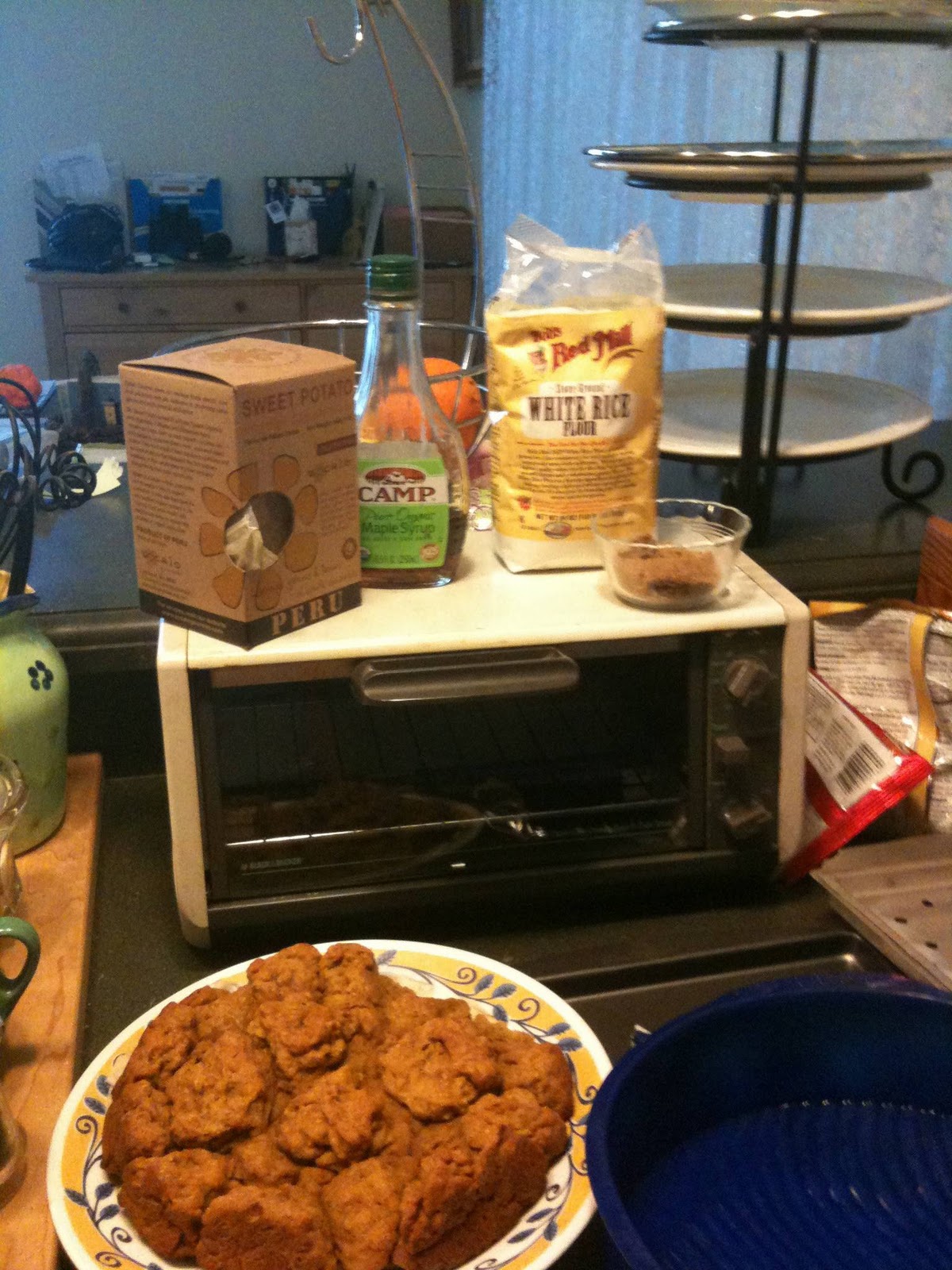
gluten-free stuff that I felt confident I had what I needed. But I didn’t have white rice flour. Looking over my stock of various flours, I thought I could make one TEENY little substitution. Well, two. I thought that sweet potato flour and maple syrup instead of white
rice flour and brown sugar would be OK.
Pride blindeth the eye–
the ingredients on the left do not
even look like the ingredients
on the right.
OK? The ingredients don’t even look alike. The failed challah looked sort of like, well, maybe a deflated
Halloween balloon. Or a bizarre orange woolen  beret with pompoms.
a failed gluten-free challah–or a hat
My son, Mike, who is not picky, told me that is  about how it tasted. FAIL!
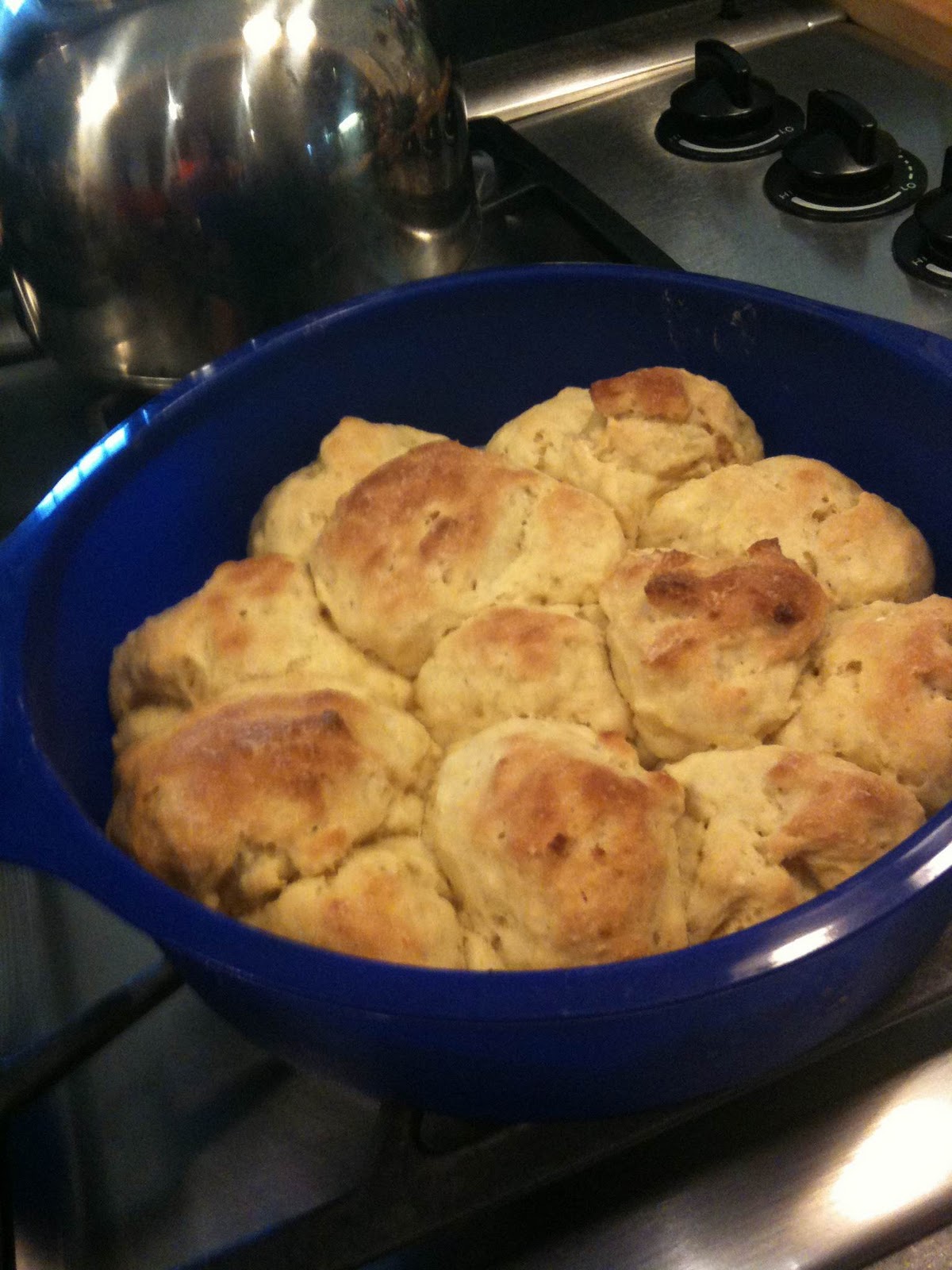
So I went to Piazza’s, which has an even better selection of gluten- free ingredients than Whole Foods got the right flour, and tried again. Success! The bread rose up, held its shape, tasted wonderful, and presented nicely. It was delicious! Ari kept going back to it. “What’s the pull-apart?” he asked, as he helped himself to another piece.
a successful gluten-free challah
 No one could believe it was gluten-free!
I also had good success with Pamela’s bread mix, which I made into challah by adding an extra egg. The batter was not cohesive enough to be formed, so I baked it in a loaf pan. It was really good, too, sliceable, and it
froze well. After the oneg, we toasted it for sandwiches all week.
The Chebe mix, based on manioc, was very pliable and cooperative, but couldn’t be made into challah, because in the oven it puffed up and then collapsed in on itself.
Chebe mix is fabulous if you add Parmesan and make it into cheese
puffs the size of a ping-pong ball. Any bigger and they collapse onto gooey centers.
Pamela’s brownie mix, which I prepared using the ‘fudgiest brownies ever’ instructions had a very strange aftertaste. But the Bob’s Red Mill brownie mix, when prepared according to directions and with the fudge frosting recipe on the package, which uses condensed milk, was a very good dessert. So was the gluten-free chocolate chip cookie mix I got at Piazza’s.
If you are keeping count, I tried six recipes; Amy Bayersdorfer’s formula, Pamela’s bread mix, Pamela’s Brownie Mix, Chebe baking mix, Bob’s Red Mill Brownie Mix, and Piazza’s gluten-free chocolate chip cookie mix. Pride prevents me from counting the recipe where I substituted the sweet potato powder for the rice flour. I served five at the oneg. As the EtzWomen advised, Amy’s recipe made the best challah and the best offering that Saturday.

Posted in Shabbat, Uncategorized | Tagged , , | Leave a comment

Olive Oil and Nationalism

Food and Whine
Hometown Olive Oil Loyalty
Ever since that one little jug of olive found in the corner of the First Temple burned for eight days instead of one, olive oil has been political. The oil had to burn for eight days so the Israelites had enough time to make more dedicated lamp fuel. Oil for the Temple had to be refined a certain way, that took a week.
Even today, olive oil aficionados are very, very particular about different grades and processes of olive oil. According to Jen Wakefield—Etz Chayim’s youth activity director— Greg Matza, the cook in her house, keeps at least
four types of olive oil on hand, each one dedicated to a special purpose. “He cooks with unfiltered olive oil, but hummus must be made with filtered olive oil,” she said. “When I go shopping, I have very specific instructions.” Jen can attest to the political passion that olive oil engenders, on an international level, too. She innocently asked a friend who makes their own olive oil in Seville, Spain what the difference was between Spanish and Italian olive oil. “I got a three-hour lecture,” she said, “with gestures and yelling.”
Go to Whole Foods, and you will see at least 15 types of olive oil, from 6 countries.
(Of course, the guy in Seville is cheering for his “home team” olive oil.) According to the Food and Agriculture Organization of the United Nations, there are over 1000 genetically distinct varieties (cultivars) of olive tree. And those are just the ancient ones. Today, there’s an extensive “farm system.” Nurserymen are constantly tinkering with olive varieties, breeding for different characteristics of fruit shape, ideal crop spacing, taste, etc. Two of the original Middle Eastern varieties are the Souri, which supposedly
came from around Lebanon, and the Nabali, or Baladi, which came from the area around Tyre.
In these modern times, the best varieties grown are exported around the world. But I found a local grower of olive oil who
has his crops in Sonoma. I asked Harry Saal what he planted in his orchard. “We have about 150 trees, split among four varietals, namely Frantoio, Leccino, Moraiolo and Pendolino,” he said. “This is a very typical northern Italian, Tuscan, mix, which gives a nice peppery bite to the back of the throat.”
Saal’s dedication to the Italian olive varieties is only natural. His wife’s maiden name is D’Esopo.
Preeva Tramiel
Tagged , , , , , , , , , | 1 Comment

A Thank -You Note! Now for mine….

In May, I got a thank-you note from a person named Scott Teitler about my apple cake.  It warmed my heart.
Never underestimate the power of a thank-you note everyone!
Now, I have to write a few of my own, since I just came back from a trip to Eastern Europe to see where my father lived, in Hungary, the Czech Republic, and Ukraine.  First,  I have to thank my guide, Alex Dunai, who took me around to places.

Then, Jewish Gen and Meyer Abramowitz, the gracious host at the synagogue in Munkach where Alex took us to trace the names of the streets in Munkach, which have changed so many times over the years, he needed he concordance Mr. Abramowitz had.

Then, the old woman whose name I don’t even know, who insisted I pose with her in the hydrangea bush in the yard where my father lived with his wife and one child.

Then, the lovely couple who hosted us for Shabbat lunch. The salmon was delicious!

Posted in Uncategorized | Tagged | Leave a comment

The Pleasure of De Feet

Question: Why would a modern woman cross the road to go to a Kosher Chicken Shechita?
Answer: To get to the other side. With feet.
I knew the Hazon conference was happening in Monterey in late December, and briefly considered going. Hazon is a good organization, dedicated to producing sustainable, organic, Kosher food.
I agree with that. I grow some of my own produce, and I sold organic fertilizer and seeds for years. I’ve taken a lot of horticulture classes, and even taught a few. But I decided not to go to the conference. Then I got this email:
“Chicken Shechita at Green Oaks Creek Farm:
For a first-hand experience in producing sustainable kosher meat — and the opportunity to take home one or more delicious, pasture-raised, kosher chickens — join us the day before the conference on Wednesday, December 23.”
I signed up. Why?
* I wanted delicious, pasture-raised, kosher chickens that were not wrapped in plastic… I hadn’t had one since 1970, when we moved away from the Bronx .
*Green Oaks Creek farm was less than an hour from my house.
*Solidarity with my foremothers, who ‘flicked’ (plucked) their own chickens.
*Chicken feet. I had not seen kosher chicken feet since 1970, either. My mother always sighed after them, claiming she missed their flavor in her chicken fricassee.
December 23rd was a perfect day to be outside, no matter what you were doing. The sky was clear and blue, and the temperature was in the low 60s. (Yes, I love California. ). We gathered at the farm, and Roger Studley , the Hazon volunteer who organized the event, had us all introduce ourselves, and name our favorite chicken parts, to break the ice. The shochet, his wife, the mashgiach had all come from New York , they were very happy with the weather. They liked thighs, wings, and grivenes, respectively. Caleb Barron, the farmer who raised the chickens, apologized that there were only 45 chickens to process that day instead of 90—a weasel had gotten into a pen and killed 45 two days before. Caleb liked drumsticks. We went around the group of about 20.
“I’m Avi, and I like skin.”
“I’m Ben , and I like schnitzel.” (That was a teenaged boy, who did not know what part of the chicken the schnitzel came from.)
“I’m Preeva, and I like wings.”
And we all went around like that. Then a man in a navy sweatshirt spoke up:
“I’m Paul , I’m a vegan, and I don’t objectify chickens.”
Then we got on with the Shechita. I dove into the chicken pens, low structures which were moved around the farm twice a day so the chickens always had fresh grass and bugs to eat, and grabbed the chickens and put them into cages to carry to the shechting station.
The shochet said the blessing for Shechita, and sprinkled some dirt into the tray that the chickens would bleed into, and said a blessing over that. Then, while we held the birds firmly upside down, the shochet slit their throats. It was all very peaceful.
Plucking was the hardest work. Starting with the feathers on the legs, you grab a handful of feathers and pull them out. The feathers grow in certain direction and you have to work with that. Misjudge their direction, and your tear the skin. Torn skin ruins the look of a roast chicken. I have a new respect for my grandmother and all the Jewish women who cleaned their chickens themselves. Koshering the chickens, which involves letting them sit in salt for an hour to draw the blood off, gave us a chance to eat our lunches and rest. Three rinses later, our kosher chickens were done.
I came home with two chickens, and five pair of chicken feet. One chicken went in the freezer for later. I koshered the chicken feet, and peeled them… I cut up my chicken for fricassee, and made soup with the wings, backs, and 4 pair of feet. Then I took my big sauté pan, the one with a cover, and browned the last pair of feet with the drumsticks, breasts and thighs. I set those aside and cooked a chopped onion till golden. Then I put the browned the chicken parts back in the pan with some water, lots of garlic, paprika, and pepper, replaced the lid, and simmered for half an hour. When I tasted it, I wept with nostalgia, transported, for a moment, back to the Bronx .
Tagged , | Leave a comment

Somewhere over the latke


Ah, the things you can do with a Cuisinart and a frying pan!
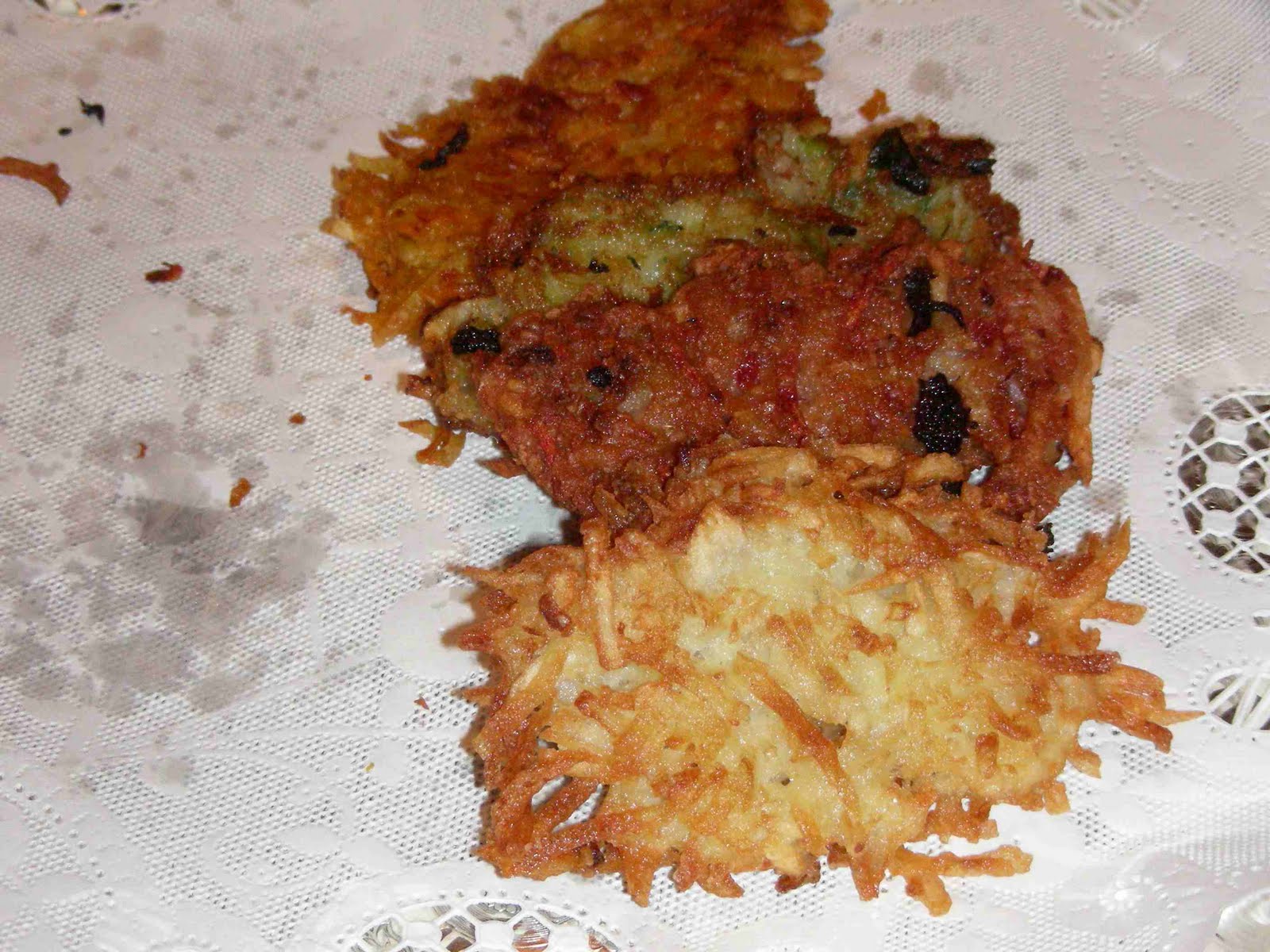
Just for fun, I looked around the garden to see what I could put in a latke. I found:
Carrots
Zucchini (from the freezer)
Chioggia Beets
and of course, potatoes
So here, they are, the Latke Rainbow Coalition!
Happy Hannukah!

Tagged , , | Leave a comment

Soup from Tubes

When I was young, soup came from soup tubes. That is what my mother called the narrow cylindrical packets of dried grains that Manishewitz sold. I think we called them soup tubes because of the space program. I was born in 1958, and when the first astronaut went up into space, we were all so excited we did things a little differently. I put a strainer on my head and played at being Little Allen Shepard. My father searched the evening sky, claiming that he, with his eagle vision (his name was Adler, German for eagle), could see the bright dot that was the rocket in the sky. My mother called her soup mix “soup tubes” because in those days, astronauts ate their meals from tubes.

They were fascinating to me, these soup tubes. They were pretty. Typically my mother bought the ‘split pea and barley’ variety, and the layers of different pulses and grains were like sand paintings or those decorative jars of foodstuffs you seen in country décor or Italian restaurants. Of course, I tried to mix up the layers of green and yellow split peas, with the barley and rice by shaking the soup tubes as hard as I could, but my mother let me. It kept me busy, I guess. These soup tubes were the basis of a weekday family staple called “mama’s soup.” Mama’s soup was extremely hearty, guaranteed to “stick to the ribs.” It was comprised of 2 or 3 soup tubes, enriched with vegetables, chicken necks, turkey necks, gizzards, leftover macaroni, and whatever else my mother had on hand that was flavorful and looked better hidden by a thick coating of split pea.

Mama’s soup taught me a number of things. First, there was analysis. You had to eat slowly and carefully just to answer the question of “what the heck am I eating here?” Visually, a plate of mama’s soup looked like split pea and barley soup with unidentifiable lumps just below the surface. If there were marrow bones, they stood out pretty well, but the gizzards, necks, rice, lima beans, vegetables, potatoes, vegetables and whatever else all looked the same. So I learned to use ALL my senses, especially touch, with my tongue, usually, but sometimes I poked at the gizzards with my fingers when my parents weren’t looking. I didn’t mind the adventure of Mama’s soup, because it was sooo good, really very delicious.

I learned to love humble ingredients from Mama’s soup. Necks, bones and gizzards contain a lot of flavor. I really loved the chicken gizzards, which Mama always managed to cook to a wonderfully chewy texture. I looked forward to eating soup the next morning, because when it was cold, you could cut the soup up into pieces with a knife, lay the slice on a plate, and go looking for your favorite ingredients. My other favorite ingredient in Mama’s soup was chicken necks. These taught me about finesse and persistence. I would spend hours, it seemed, trying to get the meat off a chicken neck with a knife and fork. I could make a meal out of a chicken neck at age 7. My mother would leave me alone at the table and do the dishes. Eventually, I would get down to the bones of the chicken neck, and then I would actually use my fingers, when I thought Mom wasn’t looking, and that was WAY fun. Good thing I was young.

When we moved out of the South Bronx into the suburbs (Yonkers) of New York in 1969, my mother stopped making her special soup. It might have been that we had more money, and she didn’t have to stretch one package of soup with odd chicken parts. It might have been because she begun reading books from Prevention magazine press, and was discovering soybeans and kiwi (then called Ugli) fruit. It might have been out of concern for my manners. A young lady of 11 was not supposed to go around sucking on chicken neck bones. That was reserved for mothers when they thought their children were not looking.
My version of Mama’s soup is very different. It’s not as thick, I don’t use soup tubes, and I don’t use gizzards or necks, but I do use leftovers. In fact, since my family is not fond of leftovers, what they get instead is soup, and they love it. Go figure.

INSTRUCTIONS FOR SOUP FROM LEFTOVERS,
ALSO CALLED ‘FREEZER SWEEPING SOUP’
OR ‘VEGETABLE SOUP WITH MEAT’
OR ‘MEAT SOUP WITH VEGETABLES’
OR ‘VEGETABLE DUMPLING SOUP’
OR ‘MEAT SOUP WITH COUSCOUS AND RICE’
OR ‘SWISS CHARD SOUP WITH BEEF’
OR ‘SPINACH SOUP WITH ROAST CHICKEN’

OR ‘Thursday Soup’

Sautee one chopped onion in a Dutch oven or medium saucepan. This fools your family into thinking you are cooking something new instead of recycling food.

Eyeball the various leftovers you have in the fridge, because this will determine the other ingredients. Meat sauce and stew make for great flavor. If you don’t have that, use powdered chicken soup mix, or stock concentrate if you have it. A can of chopped tomatoes is good too. Once you know what you are putting in the soup, add the appropriate herbs and spices. I find basil, salt and pepper go with just about everything, but if you have a lot of leftover turkey, you can add sage. Thyme is good with an onion-rich mix of stuff. Nutmeg goes well with spinach and Swiss chard, and oregano goes with chopped tomato.

If you have stock in the freezer, put that in the mix, too. Add enough water to make 4 cups or so, and add the flavoring agent (soup stock powder or soup cube or concentrated stock or whatever) and mix to dissolve everything. Once that is done, add your leftovers. If soup is not thick enough, add chopped sweet potato, or some couscous, which cooks very fast, or a package of frozen spinach. Cook until everything in the pot is done.

For an extra treat, make “shlishkes” (free form dumplings, sort of like spaetzle, but larger)

1 egg
2 or 3 tablespoons water
1 cup flour

Mix up these ingredients in a glass so you have a thick paste. Slowly tip glass so batter peeks over rim of glass, and use a butter knife to cut that crescent of batter off into simmering soup. Repeat until batter is used up. Shlishkes are done in about 3 minutes, so let the soup simmer for at least that long after you make the last dumpling.

Tagged , , | Leave a comment